Donation to

Sponsored by

Archive Home Page
Previous Exhibition Following Exhibition
St. Margaret's Hall, Coniston Road, Hatherley, Cheltenham, GL51 3NU
Donation to | | Sponsored by | |
Descriptions are based on material supplied by the layout owners
Apple Lane Mk II Apple Lane TMD is a modern image depot based in the south west servicing a mixture of DMUs, Diesels and steam. The depot sees everything from the local units to a fuel delivery through to a Rail tour or two! This layout was built to show that you don’t need big expensive layouts to still have fun! | 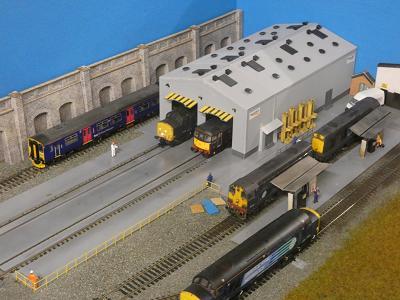 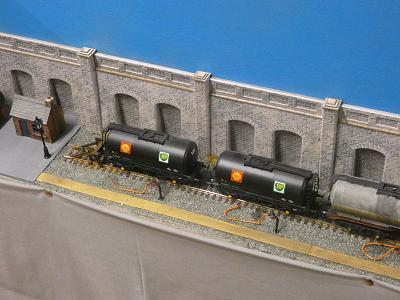 | |
 |
Ashton Meadows BR (WR) Late 1980's Ashton Meadows is a small British Rail (BR) Engineers depot, based loosely on the Ashton Meadows facility in Bristol and anyone familiar with the depot will recognize the buildings. However, it is generic in its design and can be used as if on any BR region. It is an opportunity to operate some of the vast selection of engineers stock that we have built up over the years and will no doubt involve some yellow painted vehicles as well. The layout is designed to be operated with either DCC or DC control.
Operation is as a shunting puzzle, with cards containing pictures of wagons shuffled and dealt to the various sidings for the operator to replicate. Hours of shunting fun! | |
Bristol Harbour This layout started off as a small diorama, primarily to display two scratch built Stothert and Pitt Dockside 3 Ton electric cranes, located at MShed Museum, Bristol. However, 2020 provided an opportunity to enlarge the model by constructing a few more cranes! As a museum volunteer and operator of the four surviving cranes, I was keen to make an accurate representation. Access to the museum's archive material was really useful, as well as a working knowledge. The Stothert and Pitt electric cranes were built at Bath in 1951, working at Princes Wharf, Bristol up until the 1970's They were all sold for scrap but had a stay of execution when bought back by the newly formed Bristol Industrial Museum. Over the coming years they were restored to full working order and still lift up to their maximum weights. The model continues to evolve and construction techniques improved to such an extent, that some of the cranes actually work. People often ask if they are 3D printed.....they are not!! Each part was carefully considered and a pattern created using a range of recycled materials. Some of these materials were raided from the kitchen; including a plastic milk bottle top - for the 3 Ton crane slew ring, a marmite lid - for the 10 Ton crane (crane 32) and large rivet detail.....split lentils. With the patterns made for the 3 Ton cranes, silicon moulds were made, so that repeated copies could be made. The crane 32 model is unique, and is completely scratch built. | 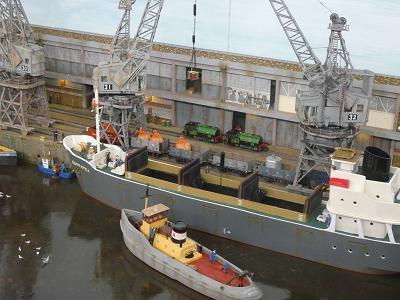 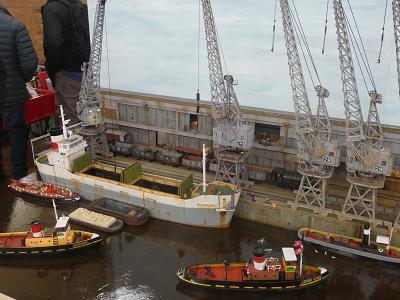 | |
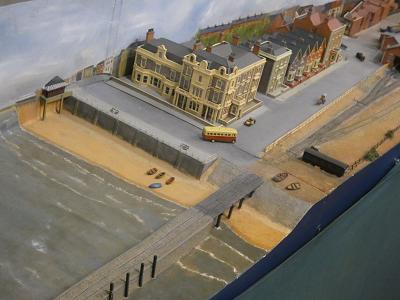  |
Situated on the Somerset coast this town once had an importance as the northern terminus of The Somerset & Dorset Railway (S&D) which linked the Bristol channel with the English channel. The pier at Burnham received rails from Welsh steelworks to be carried onwards to the expanding rail network in southern England. The S&D Railway had many bolster wagon pairs for this traffic. Pleasure ships, like the paddle steamer "Waverley" would also call in regularly during the summer, especially on cross channel trips. The pier was used by the lifeboat, which had it's own private siding. The railway station, opened on the 3rd May 1858, unusually featured a short overall roof and a long platform for excursion trains. The station closed to normal passenger workings on the 29th October 1951, excursion traffic continuing to 8th September 1962 and closed to goods on the 20th May 1963.
The model was made originally to 2mm finescale standards and exhibited by the late Denys Brownlee. After his death the model was sold and then stored for some years. I recently bought the model, by now a little worse for wear and have set about rejuvenating it to exhibit. Most work has been under the baseboards so far. Now to tidy up above and make some correct rolling stock (a big job!). It is intended to depict the S&DJR scene in the 1920's - 1930's and rolling stock is being made to show this. Current stock is mainly borrowed or adapted "N" gauge. | |
Dinas Mawddwy Cambrian Railway Dinas Mawddwy Merionethshire 1913 Dinas Mawddwy was the terminus of the Mawddwy Railway, which ran from Cemmes Road on the Cambrian main line north to Dinas Mawddwy. The original company finally went bust in 1908 having originally opened in 1867. The Cambrian reopened the line in 1911, under the Great Western passenger services were stopped in 1931 with final closure in 1951. The model represents the line as it was around 1913prior to the Great War. It is built to EM gauge with kit or scratch built stock. | 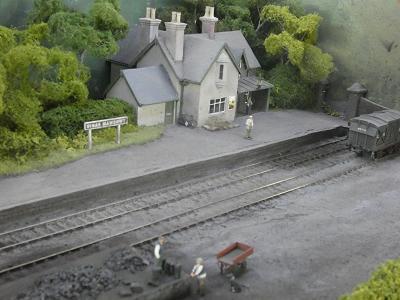 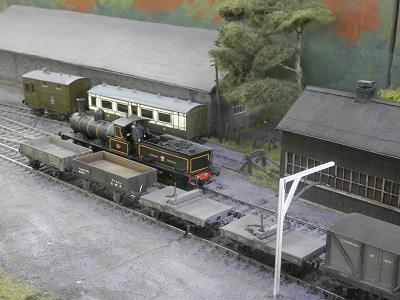 | |
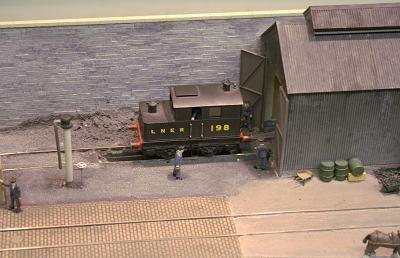 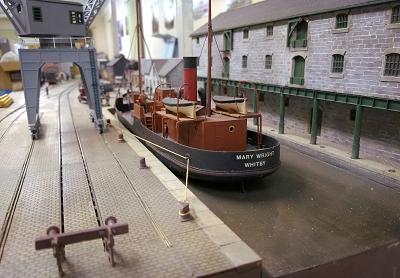 |
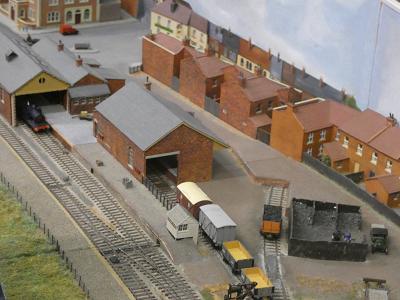
East Dock is a 4mm scale, EM gauge layout built by long time Abingdon Model Railway Club (ADMRC) member Alan Goode. Alan was acknowledged by the members of the ADMRC as one of their most skilled modelers. The whole model from the baseboards to the delightful little locomotives and rolling stock were designed and built with the thoughtful precision that Alan exuded in everything he did and it is a privilege to be able to exhibit East Dock in his memory. The layout is set in the period circa 1936 and represents one corner of a much larger dock complex somewhere in the Goole/Selby area of Yorkshire. Both the London Midland and Scottish (LMS) and the London North Eastern Railway (LNER) operated there, using tracks or running powers inherited from their pre-grouping predecessors. The locomotives are mostly kit built, with their chassis modified to in corporate compensation to improve both running and electrical pick-up. The other rolling stock is mostly kit built and is biased towards the specialist dock traffic. Most of the buildings are of plasticard embossed stone or brick on a balsawood or foamboard core. They include the original stone buildings and perimeter wall constructed by the dock company, and the scene is set by scratch-built "dirty British coaster" in the dock. | |
Fidlas Quay The layout represents a remote narrow gauge branch line on the Welsh side of the Severn Estuary. Locally produced iron goods await shipping on the next high tide while a couple of elderly Railcars provide a basic public transport facility to the sparse local population. | 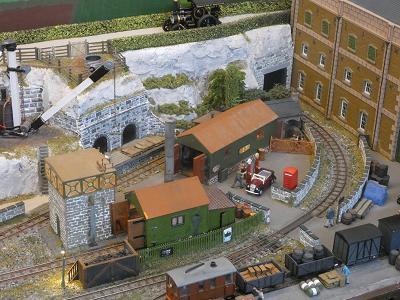 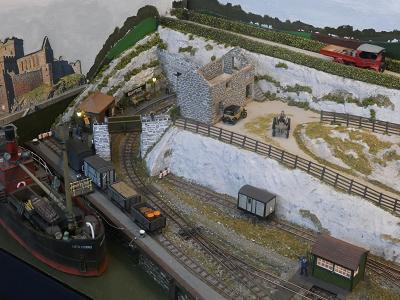 | |
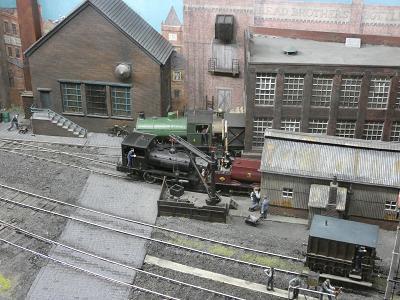 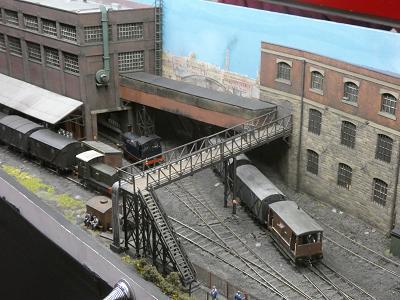 |
The layout was built for the 2002 DEMU small layout competition which among other things, stipulated that it mustn't exceed an area of 654 sq ins and have at least one working point. The track plan was arrived at using points that we already had in stock and a traverser, to save space and allow hidden sidings plus connection to the run round and grain uploading shed. We chose to model a brewery as we like beer! Such a prototype would also allow industrial buildings and a variety of wagon types. The wagons that can be seen are opens, vans, coal, grain and the odd internal user. The buildings are from the Walthers meat packing warehouse kit, from which we got the main building (with loading dock) and grain unloading building. The baseboard is built as a single unit with legs that plug into pockets underneath. The layout gives a chance to show a varied display of shunters and wagon types, some which are scratch-built. We wanted to build a layout that would be of use beyond the competition and be interesting to operate too, as such it has exceeded the original design brief. | |
Hillside Sidings The layout has been converted from a test track, previously used for automated control. There is a single preserved heritage railway line at the rear, controlled by a shuttle module. This has automatic operation allowing two trains to occupy the line at any one time, alternately. Narrow gauge 009 scale. The front part of the layout represents a modern clay single line railway with a small station and storage sidings. This line is constructed to P4 standards fine scale. | 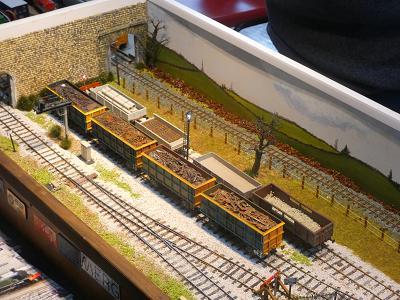 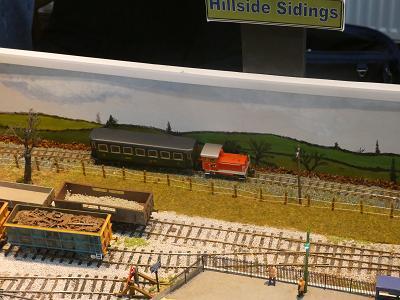 | |
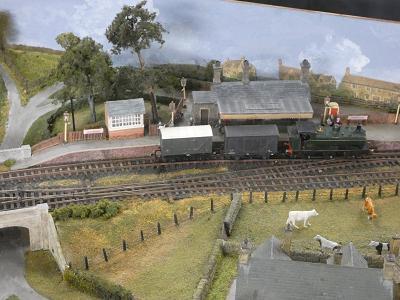 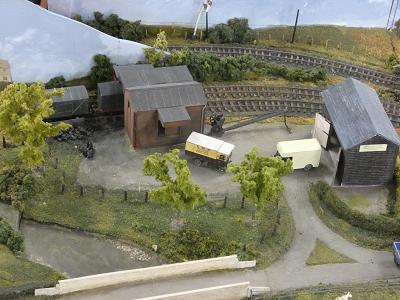 |
Hollow Fosse is a fictitious location in the south-west of the Cotswolds region. The layout represents a small rural branch line that connects with the former Midland and South Western Junction Railway. After being absorbed into the Great Western Railway (GWR) is still provided a useful link between the midlands and the south coast. Nationalisation allowed the mainline and its branches to settle into the slow rhythm of the countryside that it served. The layout endeavours to recreate the atmosphere of the late 1950's and early 1960's. The buildings many of which are modelled on actual structures, depict a typical Cotswold location. Locomotives and rolling stock are still a mixture of previous railway groups, GWR (Western), Southern and Midland including mixed trains which rationalised train movements. The layout which is L shaped has a dimensions of 5 feet by 3 feet and is operated from the rear of the 5 feet length. It is modelled on a 3mm to 1 foot scale, Triang TT. | |
Lammas Park Lammas Park was originally constructed by Roger Gould as a permanent fixture in his home. After developing Dementia the Family wanted it to go to somewhere it would be appreciated and so gave it to Phil Lovell from the Bristol East Model Railway Club. The layout has been built on traditional lines using Peco track, well ballasted and weathered. Scenery makes use of some of the current commercial well detailed buildings, all set in a semi urban / rural landscape. It runs as a GWR 1930s period layout using a mixture of ready to run and kit built stock Control is basic DC 12 volt. The layout has had one very minor adaption to enable it to run at exhibition , and now has a fiddle yard. | 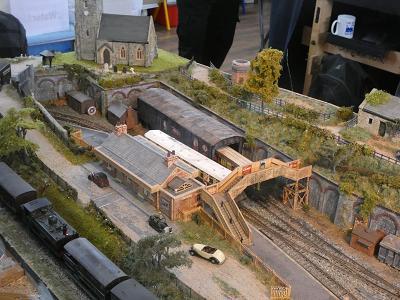 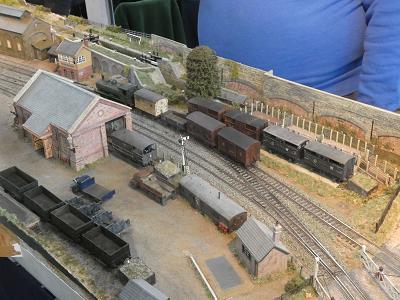 | |
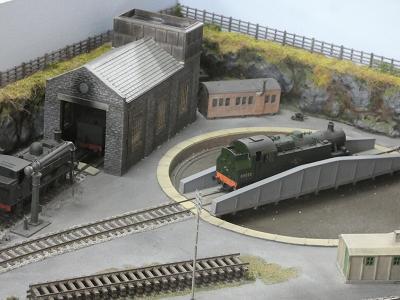 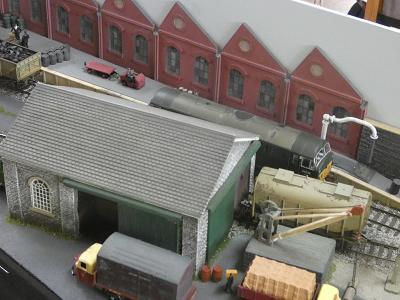 |
Porthmawgan Yard is a fictitious location set in north Cornwall. The layout has a small engine shed and goods yard, the station area being out of sight beyond the bridge. Set in the late 50s early 60s the locos etc are of mainly S.R. origin with some other visitors. Track is Peco and all major buildings are of proprietary origin. | |
Wincanton Wincanton MPD is a small motive power depot based loosely on the Somerset and Dorset. The period of the layout is circa. 1960 and most of the stock is either former London Midland Scottish or British Railways standard. Whilst the Somerset and Dorset was always a steam line, occasionally green era diesels appear, usually on the days of Wincanton races, which also brings visiting steam engines in for servicing. The layout is modelled in 2mm scale and the track is 9mm code 40 Finetrax. This accepts standard modern N gauge locomotives to be run without modification. The turntable is Peco, which has been modified to accept electrical power and the layout operation is analogue. | 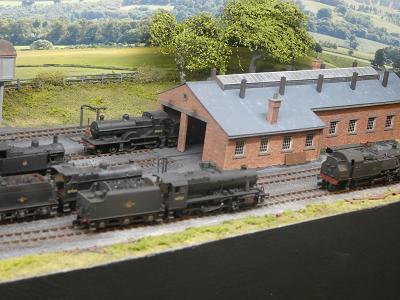 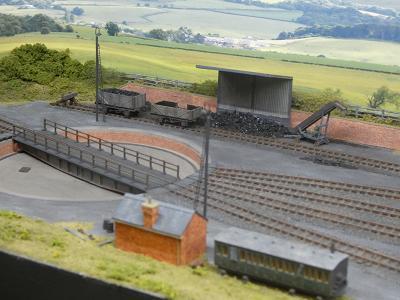 | |
| Displays | ||
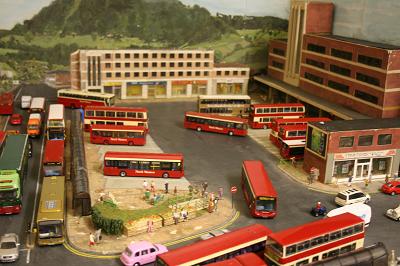
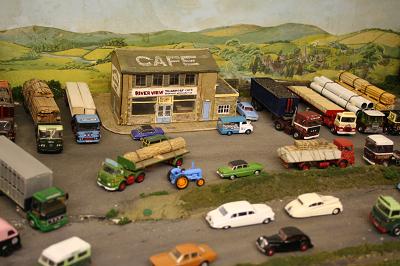
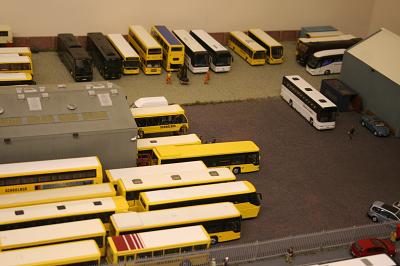
Model Bus Federation WEBSITE | NARTM (road transport) WEBSITE | |
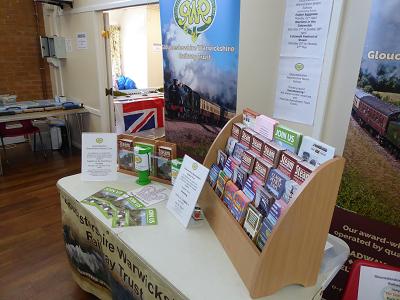
Travel 2000 Ltd | Gloucestershire Warwickshire Railway WEBSITE | |
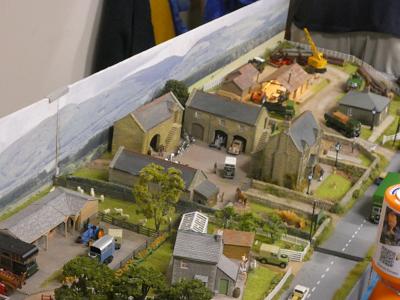
Nash Estates | Odd Menns Mills | |
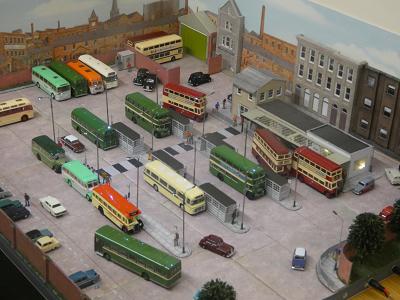
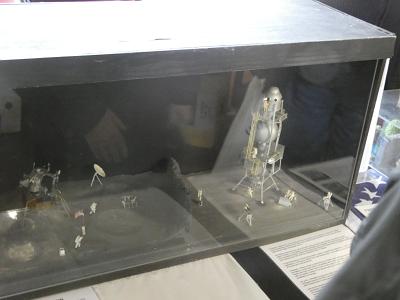
Colchester Bus Stn mid 60s | Back into space WEBSITE | |
| Modelling Demonstrations | ||
| Alex Raybould | Mark Begley | |
| Steve Harrod | Trevor Hale | |
| Trade | ||
| Five Valley Models WEBSITE | Hereford Model Centre WEBSITE | |
| Penduke Models WEBSITE | ||